

The modern path to timeless knowledge
The Faculty of
Advanced
Islamic Studies
A structured, self-paced path through the Islamic sciences.
- Accredited Diploma
- Online
- Women Only
£47per month
Begins the day you enrol · Limited places
Enrol NowView programme detailsWhy Muallimah
An institute built for serious study
Structured Curriculum
A complete pathway from Level 0 through to Iftāʾ, studied in sequence.
Trusted Accreditation
Accredited by the Ministry of Endowments and Islamic Affairs, Hargeisa.
Women-Focused Learning
A female-only institute, with a personal academic instructor.
Recognised Qualification
An accredited diploma with ijāzāt on completion.
The Faculty
What you will study
A complete, self-paced programme in the Islamic sciences. New modules each month, assignments marked by qualified teachers, every text studied in sequence.
- Qur'an
- Recitation and tajwīd, with a pathway to full ijāzah.
- Hadith
- The Prophetic tradition through its classical texts.
- Fiqh
- Studied in your chosen madhhab: Ḥanafī, Mālikī, Shāfiʿī or Ḥanbalī.
- ʿAqīdah
- Creed and the foundational principles of Islamic belief.
- Arabic Language
- From the foundations: naḥw, ṣarf and balāghah.
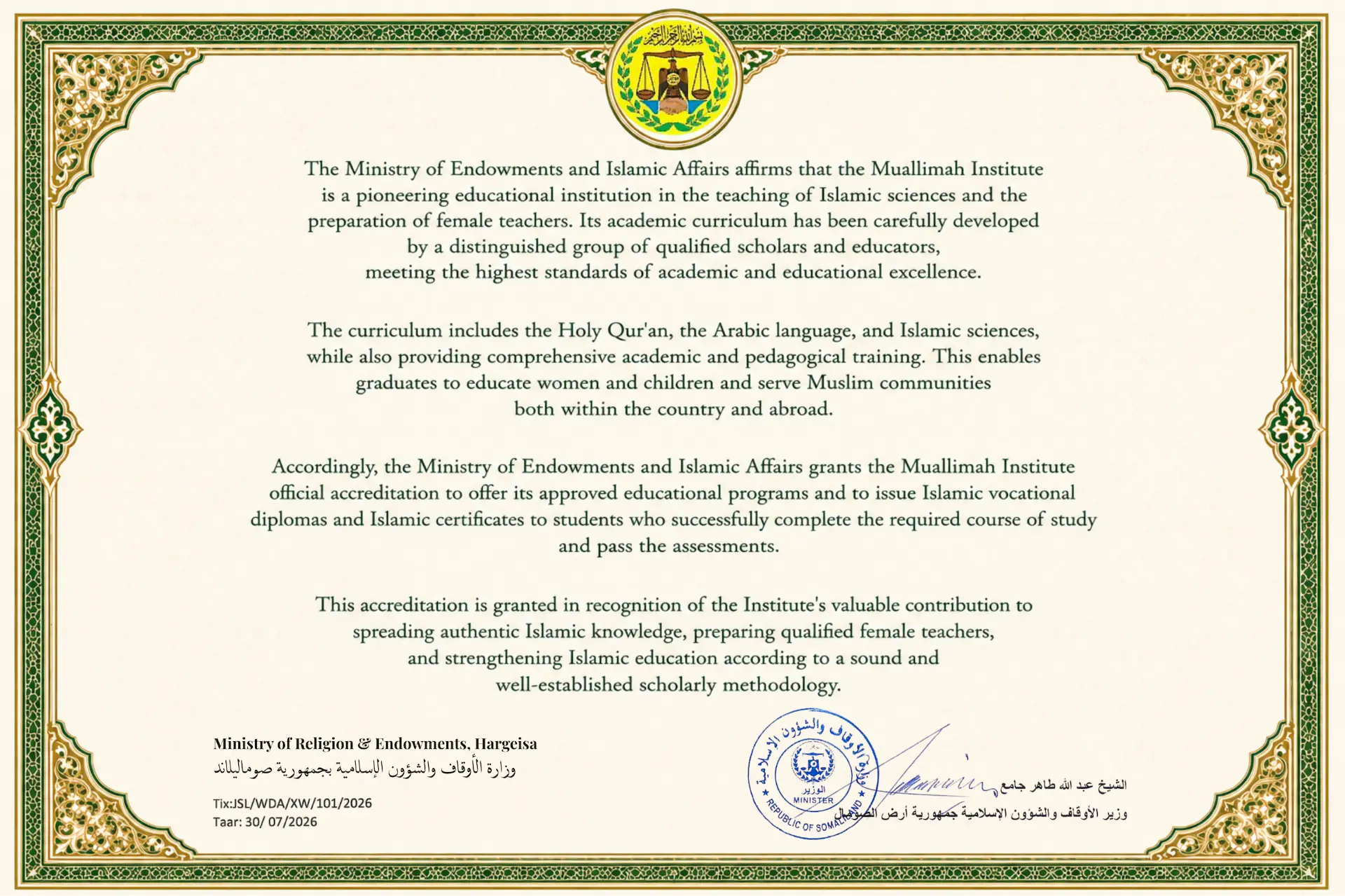
Officially Accredited
Recognised Islamic education
Accredited by the Ministry of Endowments and Islamic Affairs, Hargeisa. Graduates are awarded an accredited diploma with ijāzāt.
Tix: JSL/WDA/XW/101/2026
View accreditationThe Faculty
What you are enrolling in
Accreditation
Accredited by the Ministry of Endowments and Islamic Affairs, Hargeisa. Licence TIX: JSL/WDA/XW/101/2026
Madhhab
Four madhhab pathways: Hanafi, Maliki, Shafi'i, Hanbali
Month one
Month one is one book, An Introduction to Fiqh, read on your own
Assessment
The entrance assessment is on 30 September. Taught teaching begins after it
20+
Islamic sciences studied
100+
Classical works with ijāzāt
4
Madhāhib pathways
£47
Per month, all books included
Begin your study with us
You begin reading the day you enrol. The first month is one book, read on your own. The entrance assessment is on 30 September, and taught teaching begins after it.
Enrol Now